

Most people don’t wake up thinking, “I bet I need a root canal today.”
It usually starts smaller. A tooth that twinges when you drink something cold. A dull ache that shows up at night. A spot you’ve started chewing around without really noticing.
Then one day it’s not so small anymore.
If something about one of your teeth doesn’t feel right, this guide will help you figure out what might be going on, which signs are worth a call, and what a root canal actually involves. (Spoiler: it’s a lot less scary than its reputation.)
Table of Content
- First, What Is a Root Canal?
- 7 Signs You Might Need a Root Canal
- “It Stopped Hurting. Am I Okay Now?”
- Sometimes There Are No Signs at All
- What Actually Happens During a Root Canal
- What About an Apicoectomy?
- Is Pulling the Tooth a Better Option?
- Nervous About Treatment? You’re Not Alone
- When Is It an Emergency?
- Questions We Hear Often
First, What Is a Root Canal?
A root canal (treatment to save an infected tooth) cleans out the inside of a tooth so you can keep it.
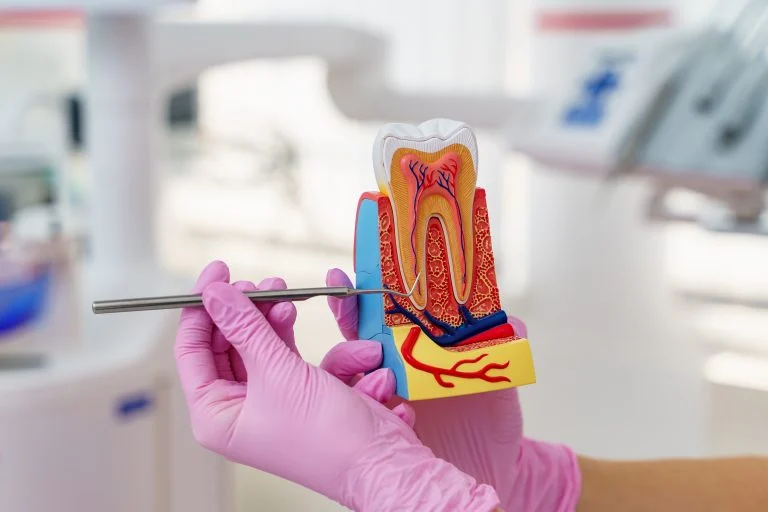
Every tooth has a soft center called the pulp. It’s where the nerve and blood vessels live. When deep decay, a crack, or an injury lets bacteria reach the pulp, it can become inflamed or infected. And because the pulp is sealed inside a hard shell, there’s nowhere for that pressure to go. That’s why an infected tooth can hurt so much.
A root canal removes the infected pulp, cleans and disinfects the inside of the tooth, and seals it up. Then the tooth gets a crown to protect it. The result is a tooth that’s healthy, pain-free, and still yours.
7 Signs You Might Need a Root Canal
Only a dentist can tell you for sure whether you need a root canal. But these are the signs that tell us a tooth deserves a closer look.
1. A toothache that won’t go away
Not every toothache means a root canal. But a deep, persistent ache, especially one that throbs or keeps coming back, can mean the pulp is inflamed or infected. Pay attention if the pain wakes you up at night or seems to spread into your jaw, ear, or other teeth.
2. Sensitivity to hot or cold that lingers
A quick zing from ice cream that fades in a second or two is common, and usually not a big deal. The warning sign is when the sensitivity lingers. If the pain hangs around for 30 seconds or more after the hot coffee or cold water is gone, the nerve inside the tooth may be in trouble.
3. Pain when you bite or chew
If a tooth hurts when you bite down, or you’ve started chewing only on one side, something may be wrong. It could be infection at the tip of the root, or a crack that lets bacteria reach the pulp.
4. A tooth that’s turning darker
A tooth that looks gray, brown, or darker than its neighbors may have damaged pulp inside. This often happens after an injury, sometimes months or even years later. It may not hurt at all, but it’s still worth checking.
5. Swollen or tender gums near one tooth
Swelling, tenderness, or puffiness around a single tooth can be a sign of infection underneath. The swelling might come and go, which makes it easy to ignore. Please don’t.
6. A pimple-like bump on your gums
A small bump on the gum near a tooth, sometimes with a bad taste or a little drainage, is often a sign of an abscess. That’s a pocket of infection trying to find a way out. Even if it doesn’t hurt, it won’t go away on its own and needs treatment.
7. A chipped or cracked tooth
A chip or crack can give bacteria a direct path to the pulp. Even if the tooth feels fine now, a deep crack can lead to infection later.
“It Stopped Hurting. Am I Okay Now?”
This is one of the most important things we can tell you: when a painful tooth suddenly stops hurting, it doesn’t always mean it healed.
Sometimes the pain stops because the nerve inside the tooth has died. The infection is still there, and it can keep spreading into the bone around the root. You may feel fine for weeks or months before it flares up again, often at the worst possible time.
So if you had a bad toothache that went away on its own, it’s still a good idea to have it checked.
Sometimes There Are No Signs at All
Here’s the tricky part. Some infected teeth don’t cause any symptoms. We sometimes find them on routine X-rays as a small dark spot at the tip of a root.
That’s one more reason regular checkups matter. We use digital X-rays, which give us clear images right away and use up to 90% less radiation than traditional X-rays. They help us catch problems early, often before you’d ever feel them.
What Actually Happens During a Root Canal
Root canals have a reputation for being painful. But the pain people associate with them usually comes from the infection, not the treatment. In fact, most people feel much better once it’s done. With modern techniques and good numbing, many patients say it feels a lot like getting a filling.
Here’s what to expect:
- We numb the area. You’ll be comfortable before we start. If you feel anxious, we can talk about sedation too.
- We open the tooth and remove the infected pulp. This is the step that stops the source of your pain.
- We clean and shape the inside of the tooth. The canals are disinfected to clear out bacteria.
- We fill and seal the canals. This keeps bacteria from getting back in.
- We protect the tooth with a crown. A tooth that’s had a root canal can be more brittle, so a crown keeps it strong.
Your crown, the same day
A lot of offices send you home with a temporary crown and ask you to come back a couple of weeks later for the final one. We usually don’t have to.
Our office uses CEREC technology to design and make crowns right here. We take a digital scan of your tooth (no messy impression trays), design your crown on the computer, and mill it in our office. In many cases, you can leave the same day with your finished crown in place. One visit, done.
What About an Apicoectomy?
Most root canals work well and last for many years. But once in a while, an infection lingers near the tip of a root even after a root canal.
In that case, we may recommend an apicoectomy. It’s a small procedure that goes in through the gum to remove the very tip of the root and any infected tissue around it, then seals the end of the root. The goal is the same as a root canal: to save your natural tooth.
Is Pulling the Tooth a Better Option?
It’s a fair question, especially if you’re worried about cost or time.
Sometimes a tooth is too damaged to save, and an extraction is the right call. But when a tooth can be saved, keeping it is usually the better choice. Your natural tooth keeps your bite even, holds your jawbone in place, and prevents neighboring teeth from shifting.
If a tooth is pulled, you’ll likely want to replace it with a dental implant or a bridge down the road. Those are great options, but they add time and cost that saving the tooth may avoid.
We’ll always talk through the pros and cons with you, so you can make the choice that feels right.
Nervous About Treatment? You’re Not Alone
If the words “root canal” make your stomach drop, you’re in good company. A lot of our patients feel the same way, especially if it’s their first time.
Our team is gentle, and we’ll explain each step so nothing catches you off guard. We also offer sedation options, including nitrous oxide, oral sedation, and IV sedation, to help you stay relaxed. We want your visit to be as calm and comfortable as possible.
When Is It an Emergency?
Call us right away if you have:
- Severe tooth pain that isn’t helped by over-the-counter pain relievers
- Swelling in your gums, face, or jaw
- A bad taste or drainage coming from around a tooth
- A tooth that’s been knocked loose or broken
If you have swelling that’s spreading quickly, a fever, or any trouble swallowing or breathing, go to the emergency room or call 911. Those can be signs of a serious infection that needs immediate care.
Questions We Hear Often
Does a root canal hurt?
The treatment itself is done with numbing, so most people feel pressure but not pain. You may be a little sore for a few days afterward, which is usually managed with over-the-counter pain relievers.
How long does a root canal take?
Many root canals can be done in one visit. With our same-day CEREC crowns, you can often have your tooth fully restored in that same appointment.
Can I just take antibiotics instead?
Antibiotics can help control an infection that’s spreading, but they can’t reach the infected pulp inside the tooth. The infection will come back unless the source is treated.
How long does a root canal last?
With a good crown and regular brushing, flossing, and checkups, a tooth treated with a root canal can last for many years, often a lifetime.
Don’t Wait on a Tooth That’s Talking to You
Tooth pain is your body’s way of asking for help. The sooner we take a look, the better your chances of saving the tooth, and the simpler the fix usually is.