



Dental implants replace missing teeth with a titanium or zirconia post that fuses to your jawbone, and most of them last for decades.
Understanding the causes of dental implant failure can help you spot warning signs early and know when to get help.
Implants fail in two general ways: early, when the bone never bonds to the post, and later, when infection, bone loss, or too much bite force wears down the support that was already there.
Both patterns have warning signs you can notice at home.
Plenty of implant “problems” turn out to be repairable restoration issues. A crown that feels wobbly often traces back to a loose screw or abutment, and that is a quick fix in the chair.
A post that moves inside the bone is a different situation and needs prompt attention.
Key Takeaways
- A loose crown is usually fixable, while a post that moves in the bone signals true failure.
- Infection around the implant, thin bone, smoking, uncontrolled diabetes, and heavy grinding are the biggest risk drivers.
- Careful planning, 3D imaging, daily cleaning, and regular checkups prevent most failures before they start.
When Is an Implant Problem a True Failure?
True implant failure means the post itself has lost its bond with your jawbone. Everything above the post, including the crown, the screw, and the connector piece called the abutment, can loosen or chip without the implant being lost.
Early vs. Late Implant Failure
Early implant failure happens in the first few months, before or during healing. The bone never fully grows around the post, a process called osseointegration.
Infection at the surgical site, movement of the post during healing, poor bone quality, or heavy smoking are the usual reasons.
Late implant failure shows up years after a successful start. Here, the implant integrated fine, then lost support over time.
Gum infection around the implant, bone loss, and years of excessive bite force are the common culprits.
Timing tells your dentist a lot. A problem at week six points toward healing; a problem at year eight points toward maintenance or bite forces.
Warning Signs That Need Prompt Attention
Call your implant dentist if you notice any of these:
- Pain that lasts past 10 days after surgery, or new pain in a settled implant
- Facial swelling that continues beyond the first 72 hours
- Gums that bleed, look red, or pull back from the implant
- Pus or a bad taste near the implant site
- Trouble chewing, or a bite that feels suddenly different
- Any sense that the tooth is shifting
None of these guarantee failure. Several are early gum inflammation, which responds well when caught fast.
A Loose Abutment vs. Implant Mobility
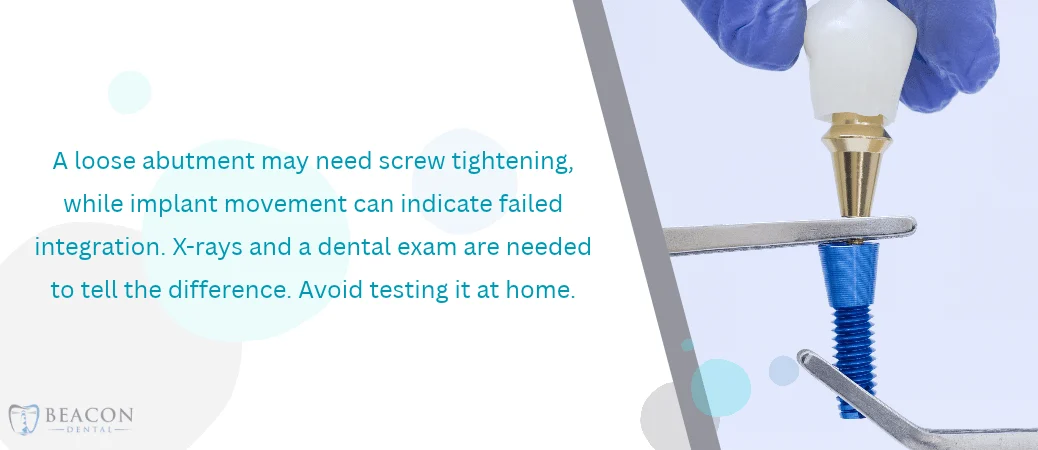
A loose abutment feels like a wiggly tooth, but the movement comes from a screw that has backed out under chewing pressure.
Your dentist removes the crown, retightens or replaces the screw, and checks your bite. Same-day fix, no surgery.
Implant mobility means the post itself rotates or rocks in the bone. That points to failed osseointegration, and the implant rarely re-integrates on its own.
Only an exam with X-rays can tell these two apart, so please skip the wiggle test at home.
What Can Undermine an Implant’s Foundation?
The three main causes of dental implant failure are bacterial infection around the implant, not enough healthy bone to hold it, and mechanical stress from placement or bite forces.
These often overlap, which is why a careful workup matters before anyone picks up a drill.
Peri-Implant Disease and Bacterial Infection
Peri-implant disease starts as peri-implant mucositis, which is inflammation limited to the gum tissue around the implant. You might see redness, tenderness, or bleeding when you brush. Caught here, it is reversible with professional cleaning and better home care.
Left alone, it becomes peri-implantitis, where the infection reaches the bone and starts to destroy it. That destabilizes the post and calls for surgical treatment.
A history of gum disease or periodontal disease raises your risk, so periodontal care should stay part of your routine after implant surgery.
Implants do not get cavities, and that fools some people into relaxing their brushing. The gums around them still get infected.
Insufficient Bone and Failed Osseointegration
An implant needs enough bone volume, density, and quality to lock into place. Missing teeth cause the jawbone to shrink over months and years, so the site of a tooth lost a decade ago often has thinner bone than expected.
When bone support is insufficient, the post never gains full stability. Bone can also weaken from long-standing periodontal disease, trauma, or certain medical conditions.
This is exactly what 3D scans are for, and it is why some patients need grafting before placement.
Placement, Premature Loading, and Excessive Bite Force
Angle, depth, and position all affect how forces travel through an implant. A post placed slightly off can carry uneven load for years until the bone around it gives way.
Premature loading means chewing hard on an implant before it has integrated. Even small movements during that window can interrupt healing. Follow the soft-food timeline your dentist gives you, even on the days you feel fine.
Occlusal overload comes from a bite that puts too much force on one implant. Heavy bite force, a crown that sits high, or long cantilevers on full-arch work all contribute.
Both titanium implants and zirconia implants can fracture or loosen under sustained overload.
Which Health and Lifestyle Factors Raise the Risk?
Smoking, poorly controlled diabetes, and untreated grinding are the three risk factors that show up most in failed cases. Each one is manageable, and each one is worth discussing honestly before surgery rather than after.
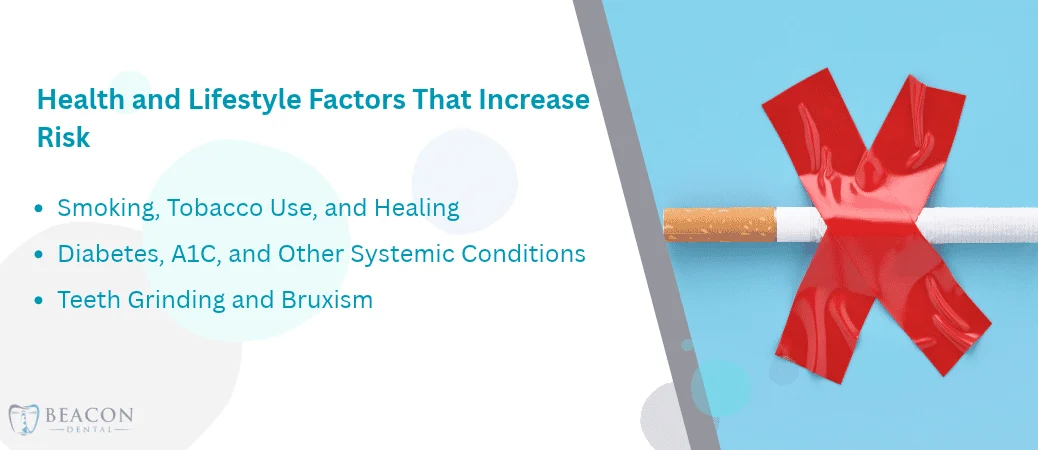
Smoking, Tobacco Use, and Healing
Smoking narrows blood vessels and slows wound healing, which raises the odds that bone never bonds to the post. Nicotine in any form, including vaping and chewing tobacco, affects the same tissue.
You do not need to quit forever to help your implant, though quitting helps most. Stopping for about a week before surgery and eight weeks afterward gives the healing tissue a real advantage.
Diabetes, A1C, and Other Systemic Conditions
Well-managed diabetes is compatible with successful implants. Uncontrolled diabetes is the concern, because high blood sugar slows healing and makes gum infection more likely.
Many implant teams want to see an A1C in a stable range before elective surgery, and coordinating with your physician is part of good planning.
Osteoporosis, autoimmune disorders, past head and neck radiation, and bisphosphonate medications also affect bone healing.
Bring your full medication list to your consultation. Bisphosphonates in particular change how the jawbone responds to surgery, and your dentist needs to know.
Teeth Grinding and Bruxism
Bruxism puts sustained pressure on an implant that a natural tooth would absorb differently. Natural teeth sit in a ligament with slight give; an implant is fused to bone with none.
Signs include morning jaw soreness, worn-flat tooth edges, or a partner who hears grinding at night.
A custom night guard made from your impressions spreads the force and protects both the implant and the crown. Drugstore guards fit loosely and sometimes make clenching worse.
If you grind hard, mention it before treatment planning. Your dentist may adjust the implant count, the crown material, or the bite design.
How Can You Lower the Risk Before and After Surgery?
Most failures are preventable, and prevention starts with the planning appointment. Good imaging, honest health history, grafting where the bone is thin, and steady cleaning afterward handle the large majority of risk.
Choose Thorough Pre-Surgical Assessment and 3D Imaging
A proper implant consultation includes a full medical review, gum health check, and a 3D cone beam scan that shows bone height, width, and nerve position. Flat X-rays cannot show width, and width is where surprises hide.
Ask how many implants the office places and what technology guides the surgery. At Beacon Dental, planning starts with imaging and a conversation about your health history before any date is set.
You can schedule a dental implant consultation to review your options and see whether your bone supports placement now.
Build a Stronger Foundation With Bone Grafting When Needed
Bone grafting adds material to a thin site so the implant has something solid to lock into. Grafts use your own bone, processed donor bone, or synthetic material, and they stimulate your body’s own bone regeneration.
Healing takes a few months before placement. That wait frustrates people who want teeth now, and it is the difference between an implant that holds and one that loosens.
Sinus lifts and ridge augmentation follow the same principle in the upper jaw.
Some patients may have implant placement options that reduce the need for grafting, depending on their bone structure and treatment plan.
Your surgeon will tell you if your anatomy allows it; oral surgery planning determines which route fits.
Maintain Oral Hygiene and Professional Implant Care
Brush twice daily with a soft brush and clean between the implant and neighbors every day. Interdental brushes, a water flosser, or implant-safe floss all work. Poor oral hygiene is the most common driver of peri-implantitis.
Keep professional cleanings every six months, or every three to four months if you have a gum disease history.
Hygienists use instruments that will not scratch the implant surface. Ask your general dentistry team to check your implant with X-rays at least once a year.
What Happens if an Implant Cannot Be Saved?
A failing implant does not mean you are out of options, and many are treated successfully without removal.
When the post has lost too much bone support, removal and a second attempt after healing is a routine path with good outcomes.
How Dentists Evaluate a Failing Implant
The exam checks three things: whether the post moves, how much bone shows on the X-ray, and whether infection is active.
Your dentist will probe the gum depth around the implant and compare current images to older ones.
If the post is stable and the problem is inflammation, treatment focuses on cleaning the implant surface, sometimes with antibiotics or surgical access to the bone defect.
Bite adjustment and a night guard often accompany that work. Many implants recover at this stage.
Movement of the post changes the plan. Once osseointegration is lost, cleaning does not restore the bond.
When Implant Removal, Healing, and Replacement May Be Needed
Removal is less dramatic than it sounds. A mobile implant often lifts out easily; an integrated one that must go is unwound with a reverse-torque tool, and sedation options keep the visit comfortable.
The site then needs time to heal, commonly several months, and bone grafting is placed at the same visit or afterward. Once the bone rebuilds, a new implant can go in.
Your dentist will also address whatever caused the first failure, whether that was smoking, blood sugar, grinding, or a bite issue.
Replacement success rates are lower than first-attempt rates, which makes fixing the underlying cause part of the treatment plan.
Early Care Helps Protect Long-Term Implant Stability

Implants hold up for decades when the foundation is planned well and cared for consistently.
The habits that protect them are ordinary: brush and clean between teeth daily, keep your cleaning appointments, wear your night guard if grinding is part of your picture, and manage health conditions that slow healing.
Pay attention to changes. Bleeding gums, new soreness, or a bite that feels different are all reasons to call rather than wait and watch. Problems caught at the mucositis stage are reversible; problems caught after bone loss are harder.
Frequently Asked Questions
What is the most common cause of dental implant failure?
Peri-implantitis, a bacterial infection that destroys the bone around the implant, causes more late failures than anything else.
It begins as gum inflammation and progresses when plaque builds up along the implant. Daily cleaning between the implant and neighboring teeth is the main defense.
What are the early signs of dental implant failure?
Watch for pain lasting beyond 10 days after surgery, swelling past 72 hours, bleeding or receding gums, pus, or any sense of movement.
Early implant failure often shows up within the first few months as the implant fails to bond with bone.
Can a failed dental implant be fixed?
An implant with infection or bone loss but no movement can often be treated with deep cleaning of the implant surface, antibiotics, or surgical repair of the bone defect.
Once the post itself moves, removal is the realistic path, followed by healing and a replacement implant. Your dentist decides based on X-rays and mobility testing.
Can a dental implant fail after 10 years?
Yes. Late implant failure at 10 years or more usually comes from gradual bone loss caused by gum infection or years of heavy bite force. Annual X-rays catch bone changes long before you would feel anything.
How can I prevent my dental implant from failing?
Clean around the implant daily, keep every professional cleaning, wear a custom night guard if you grind, avoid tobacco, and keep conditions like diabetes well controlled.
Report changes in comfort or bite quickly so small problems stay small. A team like Beacon Dental can set your recall schedule based on your specific risk factors.


